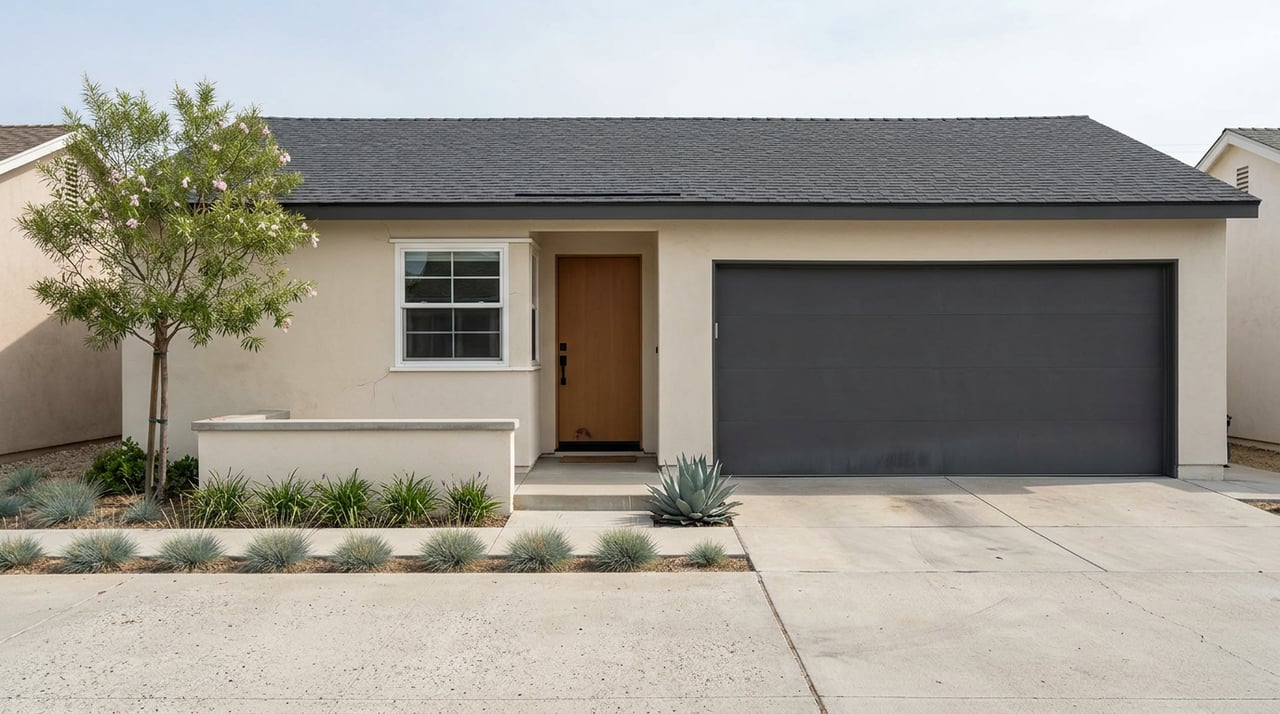
Why Does a Vista Home Cost So Much Less Than One in Carlsbad?
Pull up two three-bedroom homes built in the same decade, roughly the same square footage, six miles apart. One sits in Vista. The other sits near Carlsbad's Poinsettia corridor. The price tags can differ by half a million dollars or more. Most buyers assume the gap is the six miles of distance to the coastline, and that's part of the story. It isn't the whole story.
A meaningful slice of that gap never shows up in the sale price at all. It shows up every year on the property tax bill, and depending on when and how a neighborhood financed its infrastructure, it can keep showing up for the next twenty to forty years.
As of the first week of August 2026, active Vista listings carried a median list price of roughly $1.02 million, at about $519 per square foot, with homes typically sitting 55 days before going under contract. That's asking price on current inventory, not what actually closed. The most recent closed-sale figures published by Redfin, covering January 2026, put Vista's median sale price at $858,000, about $526 per square foot, with homes closing in an average of 44 days. Carlsbad, over the three months ending May 2026, posted a median closed-sale price of $1.5 million, with homes moving faster, in about 23 days on average, and the report's most recent single month, May 2026, showed an average sale price of $1.67 million, up 10.6 percent year over year. Inside Carlsbad, the range widens further. Master-planned pockets like Bressi Ranch and Aviara regularly see single-family homes clear $1.9 million, while coastal Carlsbad Village properties with ocean views routinely exceed $2.5 million.
That's the number most buyers see first, and it's real. What it doesn't show is the second bill.
California's Proposition 13, passed in 1978, capped general property tax at 1 percent of assessed value and limited annual increases, which protected homeowners from runaway bills but also left cities and school districts without an obvious way to pay for the roads, schools, and parks a new subdivision needs. The state's answer, four years later, was the Mello-Roos Community Facilities Act, named for its co-authors, State Senator Henry Mello and Assemblyman Mike Roos. It lets a city, school district, or special district form a Community Facilities District, sell bonds to build the infrastructure up front, and then collect a special tax from property owners inside that district to repay the bonds, typically over 20 to 40 years.
The San Diego County Assessor's office publishes a list of active CFDs by name, and the examples on that page read like a map of North County itself: Carlsbad CFD #1, San Marcos CFD 98-01, Poway Unified CFD #1. The tax is not based on a home's value. It's calculated from a formula tied to square footage, lot size, or land use category, which means two neighbors on the same street can pay different Mello-Roos amounts even if their homes are worth about the same.
Shadowridge, Vista's 550-acre master-planned community built around its own golf course, carries an effective property tax rate of about 1.11 percent and no Mello-Roos assessment. That absence is notable given the era. Most developments built through the early 2000s across North County, including plenty in Carlsbad, Encinitas, Escondido, Oceanside, and San Marcos, financed their infrastructure through exactly the kind of CFD bonds Mello-Roos was designed for. Shadowridge's golf course, parks, and streets got built without that layer, which is part of why a comparable home there can carry a lighter recurring tax load than a newer build a few miles west.
Builders have noticed that buyers now ask about this before they ask about the backsplash. Two current Vista projects make the point directly.
Neither is a budget play. Melrose Pointe is priced for buyers moving up. But the fact that a builder leads with "no Mello-Roos" as a selling point tells you the absence of that tax has become a feature buyers are willing to pay attention to, not a footnote.
Here's what the two tax structures look like set side by side, using round, hypothetical figures scaled to each market's current pricing.
| Vista, no active CFD (e.g. Shadowridge) | Carlsbad, active CFD | |
|---|---|---|
| Hypothetical purchase price | $850,000 | $1,400,000 |
| Effective tax rate | ~1.11% | ~1% base, plus Mello-Roos |
| Mello-Roos special tax | None | $1,200 to $6,000 per year, per typical 2025-2026 ranges reported by JVM Lending |
| Approximate annual property tax | $9,435 | $14,000 to $18,000 |
| Approximate monthly tax cost | $786 | $1,167 to $1,500 |
A $550,000 gap in purchase price already produces a large gap in the monthly mortgage payment. Layer in a Mello-Roos bill of even the low end of that typical range, and the Carlsbad home can add another $500 to $700 a month beyond what a size-for-size price comparison would suggest. The all-in cost gap between the two markets is wider than the median sale price gap alone lets on.
The sale price gap between Vista and Carlsbad is the number that's easy to find. The tax structure gap is the one that keeps showing up on the mortgage statement for the next three decades.
None of this makes Vista automatically the better buy or Carlsbad automatically the more expensive one once you factor in taxes. Older sections of Carlsbad Village, built well before CFDs were common, often carry no Mello-Roos at all. Some newer Vista construction outside communities like Pico Place could carry one. The city name on the listing tells you almost nothing. The parcel does.
Any buyer comparing the two markets can look up a specific address through the county Assessor's site using the parcel number, which will show exactly which CFD, if any, applies and what the current annual charge is. It's a five-minute check that changes the real monthly number more than most negotiating tactics will.
One more wrinkle worth knowing about for 2026: the federal SALT deduction cap was raised this year to $40,000, up from $10,000, according to JVM Lending's coverage of the change. That doesn't make Mello-Roos deductible on its own, and whether any portion of a specific CFD's special tax qualifies depends on what that district's bonds actually fund, something worth a conversation with a tax professional rather than a guess based on a blog post. But the higher cap means more California homeowners now have room to benefit if a deduction does apply, where a few years ago many had already hit the ceiling before Mello-Roos entered the picture.
How do I find out if a specific San Diego County home has an active Mello-Roos assessment? Use the property's Assessor's Parcel Number on the San Diego County Auditor and Controller's site to pull the current year's Special Assessments detail, which lists any CFD by name along with a contact number for the district administrator.
Does Mello-Roos ever go away? Yes. The special tax expires once the bonds that funded the infrastructure are repaid, which typically takes 20 to 40 years from formation. A district close to its payoff date carries a very different long-term cost than one that just formed.
If a home has no Mello-Roos, is it automatically the smarter buy? Not automatically. A lower tax bill is worth something, but so is newer infrastructure, a specific school boundary, or a shorter commute. The tax status is one more input to weigh against price, not a tiebreaker on its own.
Comparing two North County cities on price per square foot alone will always miss part of the story. If you're weighing Vista against Carlsbad, or any two North County neighborhoods against each other, the Cronin Team can walk through the specific parcels you're considering, tax history included, and help you see the real monthly number before you write an offer.



We strive to transform your aspirations into reality. We don't just work in real estate; we create lasting partnerships built on trust and results. Your success is our mission!

RON CRONIN | CA DRE# 01234750
MICHELLE FERRY-CRONIN | CA DRE# 02010785
EXP REALTY OF SOUTHERN CALIFORNIA, INC. | CA DRE# 02187306
(760) 421-5298
[email protected]
10620 Treena St Ste 230
San Diego, CA 92131