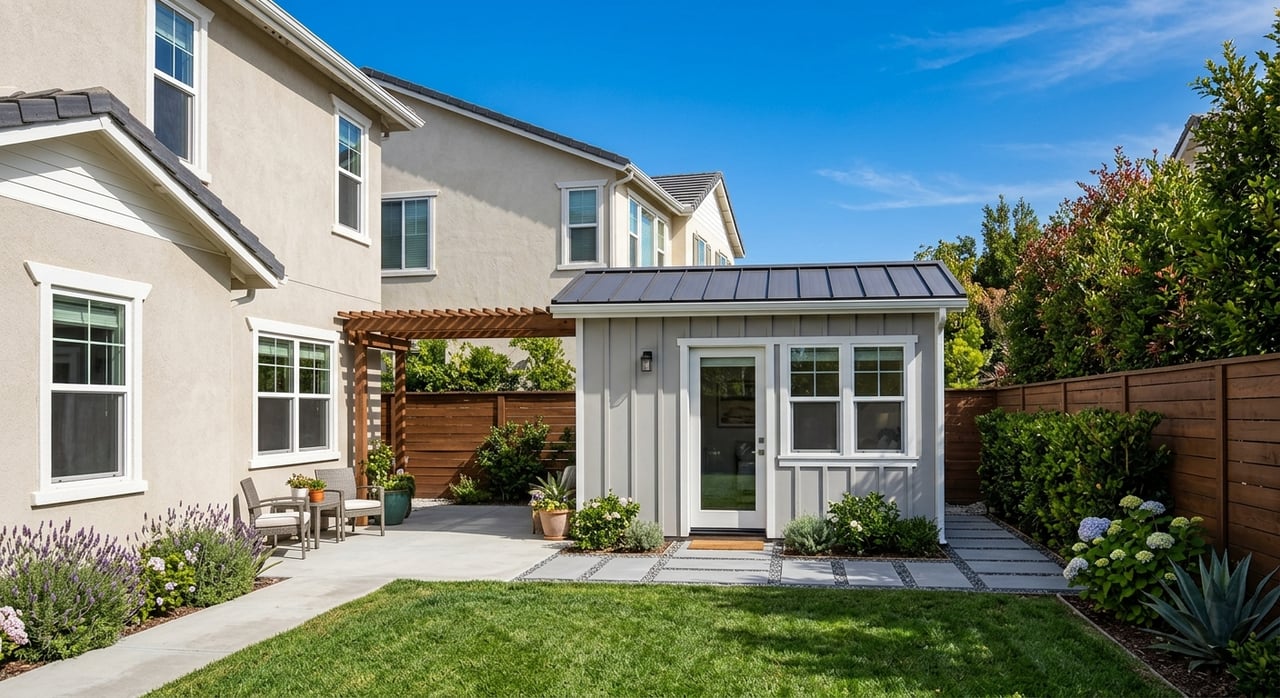
ADUs In Escondido: Rules, Costs And Investment Potential
Thinking about adding an ADU in Escondido? You are not alone. For many homeowners and investors, an accessory dwelling unit can create more living flexibility, open the door to rental income, and make better use of the property you already own. The key is knowing how Escondido’s rules, costs, and timelines actually work before you start. Let’s dive in.
An ADU, or accessory dwelling unit, is a secondary housing unit on the same lot as a primary home. In Escondido, ADUs and JADUs are allowed in zones that permit single-family or multifamily residential use, which gives many property owners a real opportunity to expand usable space or add a rental unit.
If you own a single-family property, Escondido allows one ADU and one JADU on the parcel. According to the Escondido municipal code, an ADU can be detached, attached, or created by converting existing space, while a JADU must be built within the primary home.
Before you sketch floor plans or price out contractors, it helps to understand the local framework. Escondido’s ADU process is designed to be ministerial, which means the city reviews applications against objective standards rather than through a discretionary public hearing process.
Escondido permits ADUs and JADUs in residential zones that allow single-family or multifamily use. For single-family lots, the city specifically allows one ADU and one JADU, provided the project meets code requirements.
The city also notes that single-family homeowners may choose either a standard ADU permit path or the city’s pre-approved ADU program. That option can be helpful if you want a more streamlined starting point.
One important point for homeowners and investors is that Escondido does not require owner occupancy for ADUs. That can create more flexibility if you plan to rent the main house and ADU separately or hold the property as a long-term investment.
At the same time, the city requires rental terms longer than 30 days. That means ADUs in Escondido are geared toward long-term housing use, not short-term rental use. The city code also notes that JADU occupancy rules can be more limited when sanitation facilities are shared.
Site design matters because ADUs still have to fit the lot. Escondido requires four-foot side and rear setbacks for new ADUs, while front-yard setbacks follow the standards of the underlying zone.
The city code allows a detached ADU height of 16 feet. State law now requires local standards to allow at least 16 feet for detached units and up to 1,200 square feet of detached floor area, as summarized in the California HCD ADU Handbook. Because some city public materials still emphasize 1,000-square-foot pre-approved plans, it is smart to verify the current size limits with Planning before finalizing your design.
Escondido’s code says no parking standards are imposed for ADUs or JADUs, which can remove a major hurdle for many lots. That can make it easier to move forward on properties where adding parking would be difficult or expensive.
Utility work can still affect the budget. The city code says a new or separate utility connection may be required in some cases, and proportionate connection or capacity charges may apply. Properties with private septic systems, historic resources, or Mills Act status may also face extra review steps.
The city’s ADU process starts with basic property research. Homeowners are encouraged to gather items such as APN and lot size details, then submit through the Building Division after contacting the city.
According to the city’s ADU information page, once an application is complete, approval or denial must happen within 60 days unless the applicant requests a delay. If the city denies the permit, it must provide written comments and reasons.
That 60-day window is important, but it is not the whole project timeline. In real life, your total schedule can still include pre-application research, plan preparation, plan check updates, utility coordination, inspections, and construction.
In other words, the permit decision clock may be relatively short, but the full ADU process usually takes longer from idea to move-in ready space. Planning ahead on design, utilities, and contractor coordination can help reduce surprises.
Escondido offers a pre-approved ADU program with four detached plans ranging from 484 to 1,000 square feet. The city says this program is intended to reduce design and engineering costs and shorten review time.
If your goal is efficiency, this option may be worth a closer look. A pre-approved plan will not remove every project variable, but it can simplify one of the more time-consuming parts of the process.
There is no single price for every ADU because costs vary based on size, construction type, site conditions, utility needs, and finish level. Still, there are useful benchmarks you can use to build a realistic starting budget.
A California Assembly background paper cites a 2021 UC Berkeley survey showing a median ADU construction cost ranging from $100,000 to $177,500 statewide. Detached ADUs generally cost more than garage conversions.
Escondido’s 2025 fee guide says ADUs built under Article 70 are calculated like residential room additions and are exempt from several development impact fees, including wastewater, water, traffic, drainage, park, and public facility fees described in the city’s fee chapter. You can review that in the city’s 2025 fee guide.
That said, do not assume the project will be low-cost just because some impact fees are waived. Permit fees are set by city council resolution, fees due are based on the rates in effect at permit issuance, and some projects may still require separate utility connections or capacity charges.
A few details can move your budget up or down quickly:
If you are budgeting conservatively, it helps to build in room for soft costs, utility work, and plan revisions.
If upfront cost is the biggest hurdle, there are a few programs worth reviewing. The California HCD funding page lists the CalHFA ADU Grant Program, which offers up to $40,000 for predevelopment costs.
That same HCD resource also identifies the San Diego Housing Commission ADU Finance Program, which offers construction loans up to $200,000 plus no-cost technical assistance. Program availability and eligibility can change, so it is smart to confirm current details before relying on any financing plan.
For many owners, the biggest question is whether the numbers make sense. In Escondido, the rental case for an ADU is mainly about long-term cash flow, since rentals must be longer than 30 days.
As a rough local benchmark, Apartments.com reports Escondido rent averages of about $1,598 for studios and $1,963 for one-bedrooms as of March 2026. Actual ADU rent will vary based on unit size, layout, finishes, utilities, and location, but those figures offer a useful starting point for smaller units.
The strongest ADU investment cases often combine more than one benefit. You may be looking for monthly rental income today, housing flexibility for family or caregivers, or a future downsizing option on your own property.
Statewide context also supports the broader demand story. The same California Assembly housing report says ADUs accounted for about one out of every five legally constructed homes in California, with more than 23,000 legal ADUs completed in 2023.
That does not guarantee a specific return, of course. But it does show that ADUs have become a meaningful part of California housing supply, and that helps explain why so many homeowners are taking a serious look at them.
A fully permitted ADU can make your property more flexible to future buyers. Some buyers may value the option for rental income, guest space, a home office, or multigenerational living.
The safest way to view resale is this: an ADU may broaden your buyer pool, but any price premium depends on the lot, layout, permit status, unit quality, and market conditions at the time of sale. It is a benefit worth considering, but not one to treat as guaranteed.
In Escondido, ADUs can make sense for several types of property goals. You might be a current homeowner planning ahead, an investor evaluating long-term rental potential, or a buyer searching for a property with enough space to add future value.
If you are shopping for a home with ADU potential, it is especially important to look beyond the house itself. Lot layout, setbacks, utility access, and zoning can make a big difference in what is realistic.
An ADU in Escondido can be a smart way to add flexibility, create long-term rental income, and make fuller use of your property. The opportunity is real, but the details matter, especially when it comes to site constraints, utility costs, permit timing, and the difference between city materials and current state rules.
If you are weighing whether to buy, hold, improve, or sell a property with ADU potential in North County San Diego, working with a local team can help you look at the bigger picture. The Cronin Team - Ron and Michelle Cronin can help you evaluate how ADU potential fits into your real estate goals.
We strive to transform your aspirations into reality. We don't just work in real estate; we create lasting partnerships built on trust and results. Your success is our mission!

RON CRONIN | CA DRE# 01234750
MICHELLE FERRY-CRONIN | CA DRE# 02010785
EXP REALTY OF SOUTHERN CALIFORNIA, INC. | CA DRE# 02187306
(760) 421-5298
[email protected]
10620 Treena St Ste 230
San Diego, CA 92131